Commercial Radio Bleating
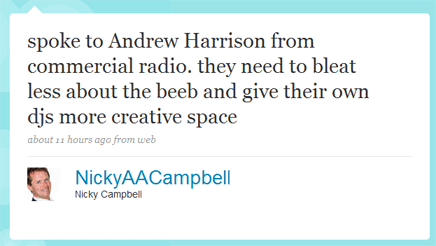
I saw this tweet and had mixed feelings. The whole issue has me a bit torn.
I'm not a big fan of commercial radio slagging off the BBC. The beeb makes excellent radio programmes. They're made by passionate people and funded the tune of £460m a year. It combines this quality with an amazing distribution network (national analogue coverage, DAB coverage, digital television, streaming and listen again) and strong marketing on television, radio, outdoor and online. This results in high listening figures and strong audience appreciation. As it should.
Commercial radio, on the other hand... geez where to begin. All 250+ stations in the commercial radio network, generated, last year, in total, £515m in revenue. For this money it has to run interruptions to its programmes - adverts, sponsorships etc. It also has to maintain over 100 more buildings than the BBC. It has to spend a great deal of money generating this revenue - sales people etc. It also has to make a profit (or at the least not make a loss). At the same time commercial radio has no national FM pop network. Indeed it only has one national FM network at all - a classical music service - Classic FM.
It takes on the BBC's pop networks - Radio 1 and Radio 2 - in each local market. Due to the regulatory structure it has to field around 200 individual competitors to Moyles and Wogan in TSAs that range from 50k people to 10m. Listeners make no distinction between how stations are funded (why should they care) they just want to listen to what suits them best. The vast majority of commercial radio stations currently lose money.
If you own one of these local radio stations is it any wonder that you look at the BBC with envy? Don't you think, if you could, you might try and remove one of the many clubs that beats you into the ground?
An easy response is "They knew what they were getting into when they bid for the licence". Partly. There's a recession on you know, that has somewhat affected how well stations do. Even the good ones. Plus the BBC's stations can (and do) change quite significantly. When people won their licences, mostly around ten years ago, Radio 2 did something different. It was a radio station that attracted an older audience. It now adds younger listeners faster than any demographic. It is, without question, a younger sounding radio station than it was ten years ago. I'm sure a number of commercial radio business plans did not predict that the Radio 2 tanks would be so far on their lawn that the shed's looking threatened.
I'm not denying that Radio 2 is an excellent radio station. It is! But you look at a show like Alan Carr and Emma Forbes' 'getting ready to go out' show and it doesn't exactly emit Reithian qualities, does it? If you run a TSA of 250k and run a 'getting ready to go out' show for 25 to 44s how are you expected to compete with a programme on the BBC that's promoted on TV, ad free, presented by two well known and talented presenters, on any radio platform you may want to consume it on and plays songs, all of which, would appear on Heart.
So if you're a commercial radio station you have the option of doing your own version or counter-scheduling. And should a commercial radio station, of which this kind of show is there bread and butter, be forced by Radio 2 to put on something else?
But, I suppose if we follow Nicky's advice we should just let the DJ have more freedom and that would fix all the problems. Yeah right.
There are two reasons why local radio DJs don't talk as much as presenters at BBC stations.
1. They're not as good.
I'm not saying they're rubbish at all. But if you're on a national BBC network you are, of course, going to be better. Commercial radio will be playing catch up.
2. They have to play adverts.
Ads are interruptions to music. It's not ads that listeners find annoying, it's interruptions to the bits 'they like'. This can be a duff song, an over-long link or a presenter they don't like. In commercial radio we're already doing ten (often more) minutes of interruption an hour, with the rest of the time, what are you going to do? You're a music radio station. The most sensible thing to do is play more music - and that's music that you know your listeners like. The alternative is to talk more and play a few more unfamiliar songs. This increases the chances of listeners finding more bits they don't like. I'm over-simplifying this, but at a BBC station you have those ten minutes more to play with; to do things that might not work, or play a song that might not be familiar and still have the same level appreciation as a commercial radio station that has to be perfect in the ears of listeners for the other 50minutes.
This was only going to be a short post....
What BBC radio does cannot be compared to commercial radio. It's like comparing apples and formica tables. Radio 1 online has more staff than the whole of XFM and Capital FM's on-air and on-line production team . I'm not saying that Radio 1 shouldn't be allowed to make great websites, i'm just saying that the two sides are actually completely different industries.
There is no doubt that commercial radio could do a better job in some areas. However when you look at what's stacked against it, it's really amazing it can do as well as it does.
The reasons it complains about the BBC is because even if it succeeds in the smallest of its suggested changes the effects are potentially huge. Moving Radio 2's average age just ten years older would probably allow a decent number of stations to return to profitability. We're not talking about Murdoch-style dominance. We're talking about local radio stations being able to exist.
Actually I think what annoys me most about Nicky's tweet (and the other BBC staffers who re-tweeted it) is what they're actually doing is dismissing as idiots the people who are trying to make entertaining radio on miniscule budgets in super-small areas in a massive recession.
I own a loss-making, little radio station. It's currently losing less money than it's ever lost before and with a prevailing wind i'd hope we could turn that into a small profit by the end of the year. We are a national radio station for children under ten. We try not to bleat about 'the situation we're in', we, like most people in commercial radio just get on with trying to do what we can and make an interesting, popular radio station. I try not to think too much about the BBC's kids radio output. What they do is excellent and what they spend on it (compared to what we can afford to spend) is Brewsters-Millions-style huge. I can't think about it too much, otherwise the envy would become all-consuming. And to exist, it's something I have to compete with.
The BBC recently moved the majority of their kids radio programming to breakfast time. This is, potentially, like most commercial stations, the slot where we can make the most money. There was no consultation for the programme change or a market-value test investigating whether they should be allowed to concentrate the majority (of the large amount) of money that they spend into a show that competes directly with the most important part of the only commercial radio competitor.
Nicky - letting my DJs 'be more creative' won't help me fix this new problem.
I have not 'bleated' about this - until now. I'd hope you'd allow us (and other radio stations who have to satisfy different audiences, in different ways, to survive) to be able to suggest (with evidence) that it's not your existence that threatens us it's your ability to change, grow and get stronger, whilst simultaneously being able to pull the rug from under our feet, using our money.